Constantia Blinds / The Field Guide
A wine-valley shading field guide
The Constantia Valley Light & Shade Field Guide
Three centuries of building stock, the wettest winters in the Cape winelands, a west wall the Constantiaberg rescues early, and a January south-easter. Written window by window for this valley — not lifted from a catalogue.
Take this guide with you as a PDF — 12 pages, 1.0 MB, everything on this page.
One valley, two building stocks that want opposite things
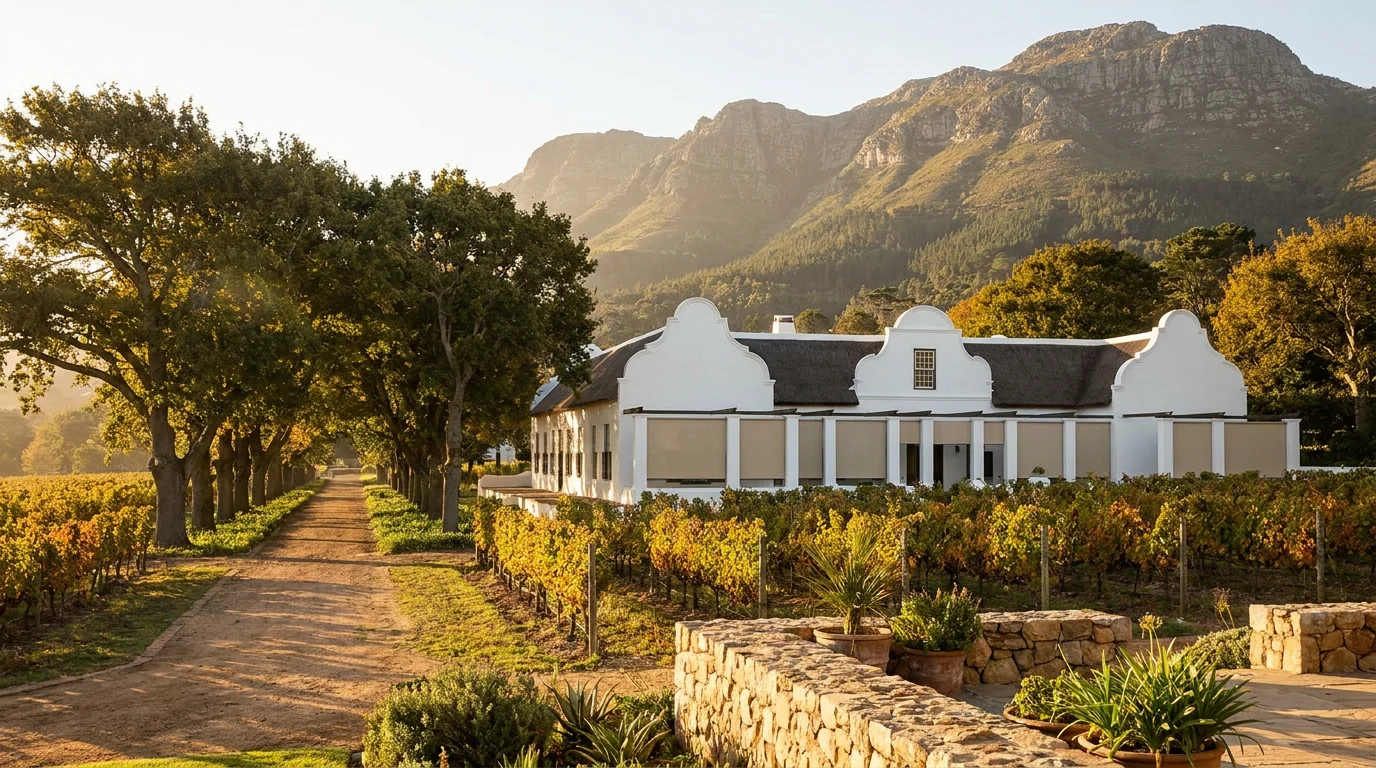
Drive from the top of the valley down towards the vineyard edge and you pass three centuries of South African house-building inside a few kilometres: thick whitewashed walls with small deep-set openings, mid-century family homes buried under oaks, and newer architect-drawn houses that are essentially glass with a bit of steel holding it up.
Those buildings do not want the same blind. Constantia is one of the oldest wine districts in the southern hemisphere, and the heritage stock — Cape Dutch and Cape Dutch-revival, with Groot Constantia’s 1692 manor setting the tone the whole valley borrows from — is built around deep reveals, timber sashes and old steel casements. A few hundred metres away sits a frameless glass corner four metres tall. What suits one is close to useless on the other, and a single spec across both gets one of them wrong.
Then there is the weather, which is not the Cape Town most people picture. This valley catches more rain than any other Cape wine region — up to roughly a thousand millimetres in a wet year. Damp is what kills hardware here. Salt, this far from the sea, barely registers.
And the glass almost always exists for a reason: the vines, the oaks, the Constantiaberg. So the brief is rarely “block it out”. It is closer to keep the view, kill the glare, get the heat off the pane, and fix it to something that will still be sound after ten wet winters. What follows is how we’d work through a house on exactly that basis.
Overhead in December, raking in through June, gone early behind the ridge
Constantia sits near 33.9° south. That puts the sun in the northern half of the sky all year round, and swings it a long way between the solstices. Around 21 December the midday sun stands roughly 79° up — near enough overhead that an ordinary eave is already shading a north window for you. Around 21 June it manages only about 33°, raking low across the north all day and reaching well into north rooms. In July that is warmth you want, not a problem to solve. (Both figures come off the latitude and the standard solar declination — calculated, not measured on site.)
West is where it goes wrong. From the middle of a high-summer afternoon the sun drops below every eave and lands square on the glass. The valley does get one break the flatter suburbs never see: it goes behind the Constantiaberg well before it reaches the horizon, so the west elevation is released earlier than an open aspect would allow. The trouble is the hour or two beforehand — low, direct, and carrying Cape Town’s summer UV, which runs to an index of 11 to 14 from October through March. That is what fades a fabric and loads heat into a room.
Wind decides the exterior half of the answer. The south-easter blows hardest from November to March and peaks in January, squeezed and accelerated by the mountains either side. Down in the valley you are far better sheltered than anyone on the Cape Flats, but an exposed terrace or a first-floor window still takes it. That is why anything external we quote here carries a wind sensor as standard, rather than as an extra line further down the page.
Begin at the hardest wall, then work round the house
Two hard hours, then the ridge
Low summer sun straight onto whatever faces the vines, under any eave, until the Constantiaberg finally cuts it off. Every rand spent stopping that heat on the outside of the glass does more work than the same rand spent inside. If the house only ever gets one exterior product, it belongs on this wall.
Generous in July, loud in January
The eave carries most of the summer load because the sun is so high, so the complaint here is usually glare and fade rather than heat. A sunscreen handles both and leaves the vineyard where you can see it. Whatever you fit, keep the winter sun — you will want it back by May.
The five-o’clock dawn
Sharp light on breakfast rooms and east bedrooms in midsummer, then very little after eleven. Bedrooms need a genuine blockout for that early hour. Living rooms almost never do — a light-filtering fabric takes the edge off without leaving the space dim for the rest of the day.
Dim, cold, slow to dry
Barely any direct sun, deep oak shade, and the wettest winters in the Cape winelands. Nothing on this side is a glare problem. It is a warmth-and-moisture problem, which points straight at insulating fabrics and finishes that shrug off damp instead of holding it.
Seven decisions, and what each one costs you
Nothing below comes without a downside, so the downside is printed right next to it. Hit Add on anything that sounds like your house and it drops into the ballpark tool and the free-measure list further down — carry it into either path without typing it twice.
Start with the joinery: what an old reveal will actually take
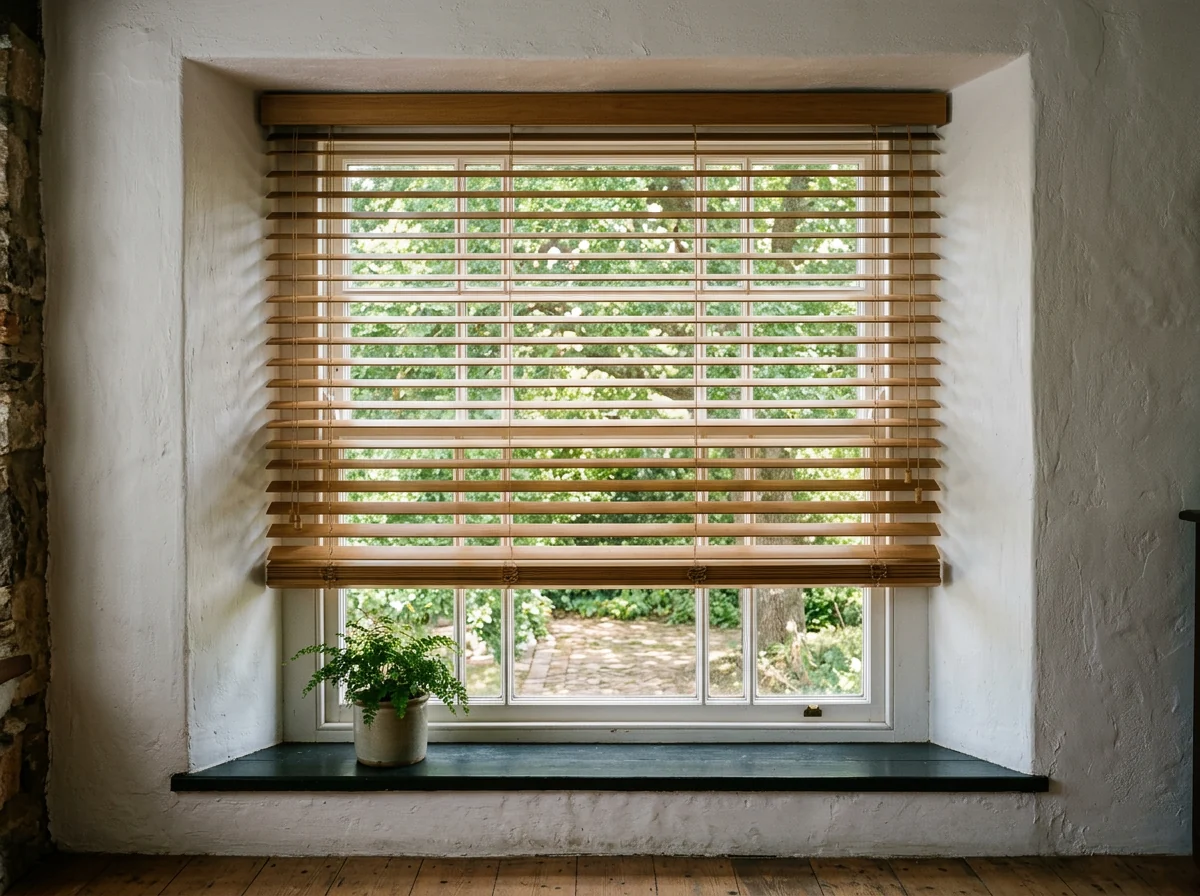
On a Cape Dutch-revival sash or an old steel casement, the blind is the easy part. The fixing is the decision. A wide-slat timber venetian sits properly inside a deep whitewashed reveal, tilts the dappled oak light exactly where you want it, and looks like it belongs to the age of the window. On original joinery, in a room that stays dry, it is the handsome answer and we will say so.
What it costs you: raw timber in a bathroom, a kitchen, or a south room that sweats its way through a Constantia July will move, cup and mark — and you will be rehanging it. In those rooms we switch to a slim aluminium venetian with a sealed powder-coat finish. Identical tilt, identical control, no argument with the damp. Same product family, opposite room.
Anything with a view: mesh before you reach for something opaque
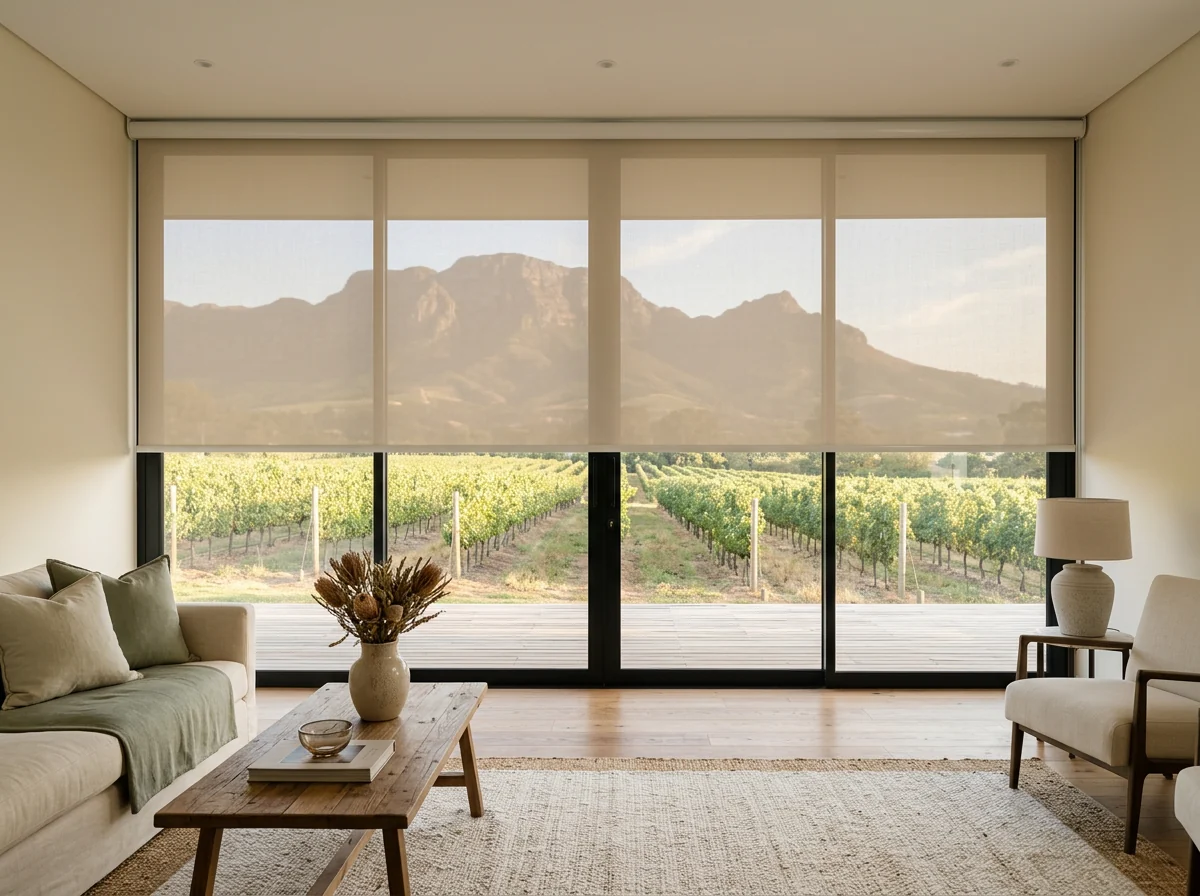
Most of the glass in this valley was put there to look at something — a vine row, an old oak, the mountain behind it. Hanging an opaque blockout on that window to fix midday glare solves the glare by deleting the reason the window exists. A sunscreen mesh cuts the glare and the UV and leaves the view as a soft silhouette; how open the weave should be depends mostly on how close that view sits to the glass.
What it costs you: a sunscreen is honest about one thing — it is not a night blind. Lights on inside, garden black outside, and the mesh works in reverse. That single weakness is the entire argument for the double roller a little further down.
The west elevation: outside the glass, or accept the compromise
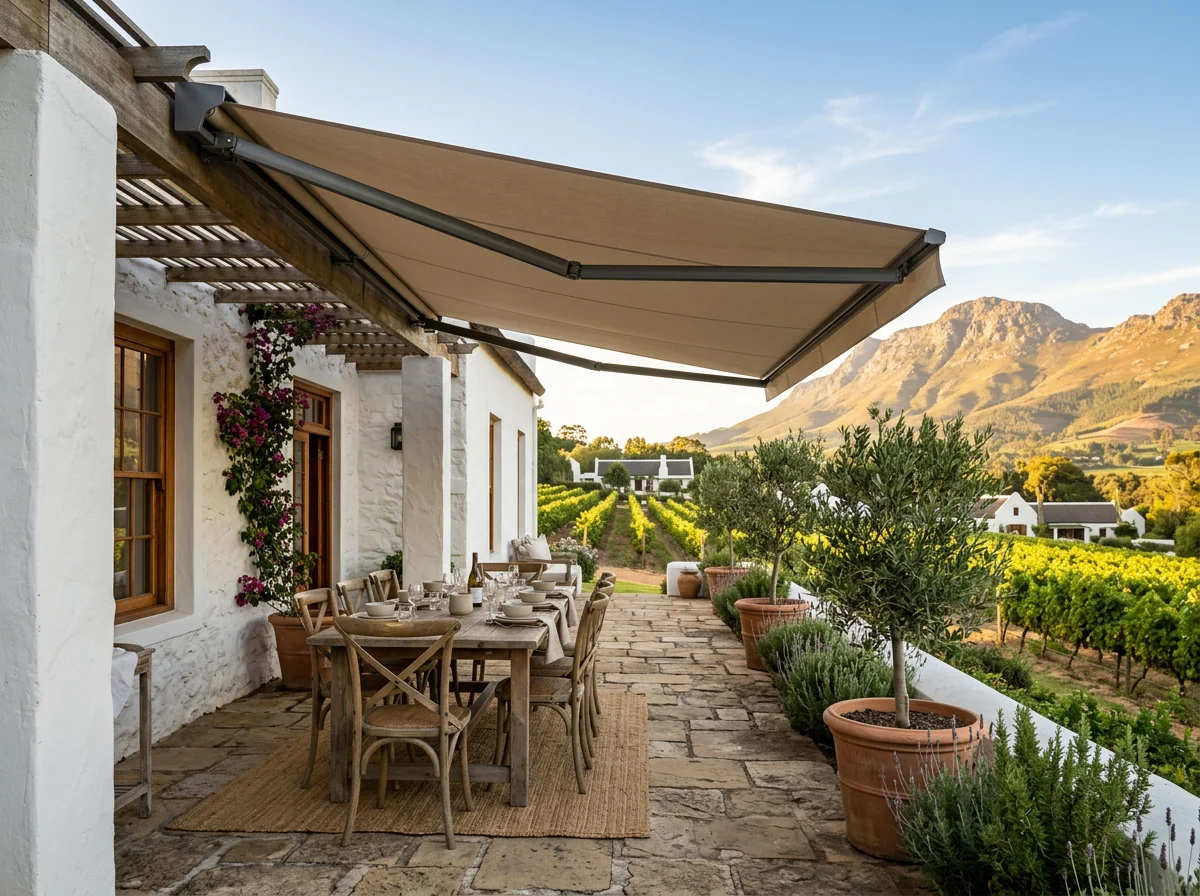
Physics is not negotiable on this wall. An external layer — a folding-arm awning over the terrace, an external venetian dropping in front of the pane, a zip screen held taut in its side channels through the south-easter — intercepts the sun before the glass ever absorbs it. An interior blockout waits until the pane has warmed through and started radiating into the room, then stops the light. Both darken the room. Only one of them keeps it cool.
What it costs you: more money, a motor and a wind sensor to survive January, and a visible change to the elevation — no small thing on a heritage facade or inside an estate’s architectural guidelines. Where either rules it out, a high-performance sunscreen inside with a blockout behind it is the honest second-best. We will tell you that plainly rather than pretend the two are equivalent.
One bracket, two fabrics: the day-and-night roller
Where a room needs the view in daylight and a proper screen once the lamps go on, a double roller carries a sunscreen and a blockout on the same bracket and you run whichever the hour calls for. It is the direct fix for the sunscreen’s one flaw, without a second blind and a second headbox appearing on the wall.
What it costs you: a deeper headbox, and a bit more than a single roller. In a room that genuinely only ever wants one of the two, a single blind is neater and cheaper. Do not buy the pair out of habit.
Bedrooms facing a midsummer sunrise
North and east bedrooms have to hold their dark past a five-o’clock December dawn, and a blockout roller does that with no fuss, no maintenance and no drama. That is the default here, and for most rooms it is also simply the right answer.
What it costs you: very little — unless the room is also cold. On the shaded south side a plain blockout gives you darkness and no help at all with the chill, and that is where a blockout cellular earns the extra spend: the same darkness plus a real insulating layer. Cold room, spend it. Warm room, don’t.
The cold half of the house
Most Constantia homes have two or three rooms nobody sits in between June and August — south-facing, under the oaks, permanently a few degrees behind everywhere else. A cellular honeycomb is the warmest blind we fit: the pleated cells hold a pocket of still air hard against the glass and slow the heat leaking out through a cold pane. Ordered top-down/bottom-up it lets daylight in high while keeping the room private at eye level.
What it costs you: more than a roller, and a fabric that wants gentle handling rather than a wet cloth. It is also the wrong hero on a baking west window — it manages light and holds warmth; it does not stop a low afternoon sun. Send it west and you will end up disappointed in a good product.
Four metres of glass, and nowhere sensible to put a chain
The newer houses here run to frameless corners and double-volume glazing built around the vineyard. A control chain hanging four metres down that glass undoes the drawing. A concealed roller solves it by living in a slim ceiling slot or a plastered bulkhead: raised, the opening reads as glass and frame and nothing else.
What it costs you: concealed means motorised — nobody reaches into a ceiling slot — so there is a motor, a power route, and a decision that has to be made before the ceiling closes. Retrofitting one afterwards means chasing plaster. On an ordinary-height window within arm’s reach, a tidy surface-mounted roller shades exactly as well for a fraction of it.
Three things that slow a Constantia job down
Old joinery, first. Groot Constantia’s manor — built in 1692, restored by F.K. Kendall in 1926–27 — is the reference half this valley’s houses borrow from, and a good deal of the joinery under that look is genuinely old. We will not force a standard bracket into an original sash or a period steel frame. A slim venetian headrail inside a deep reveal, or a roller face-fixed above the opening onto the masonry, usually solves it without a screw going anywhere it shouldn’t.
Estate guidelines, second. A large slice of Constantia sits inside wine-estate and security-estate developments, and most of those carry architectural rules covering exterior colour, fascia lines and what is allowed to hang on an elevation. Anything external — awning, external venetian, zip screen, roller shutter — gets checked against your scheme before it reaches a quote, not after it arrives on the back of a bakkie.
Access, third, and it is the one everybody forgets. Long screened driveways, gated entrances and estate booms are ordinary here. We note the access at the measure so the fitting team is not parked at a boom with a van full of made-to-measure blinds that fit exactly one house in the country.
Where the guesswork actually ends
Everything above gets you to the right kind of product for each window. It cannot get you to a price, because six things only show themselves once somebody is standing in the room with a tape — and they are the six that decide whether a blind is still square and quiet in five years:
- Whether the opening is square at all. Old Constantia reveals often are not, and a blind cut to one measurement across an opening that runs out by a couple of centimetres will show a wedge of light down one side forever.
- How deep each reveal runs — whether the blind can live inside the frame or has to face-fix above it, which is the first thing that changes on thick heritage and steel-framed openings.
- What is actually behind the plaster — brick, a timber lintel, steel, or a hollow bulkhead — because that picks the bracket and decides whether a heavier motorised unit can hang there safely.
- How exposed that particular terrace or upper window is to the south-easter — the difference between a canopy awning and a zip screen in channels, and whether a wind sensor is essential rather than nice to have.
- How the south and canopy-shaded rooms breathe — where condensation collects through a wet winter, and therefore where sealed aluminium quietly beats timber no matter how good the timber looks.
- Where a motor gets its power on the concealed and double-volume installations — battery or wired, which route it takes, and what has to happen before anyone closes a ceiling.
Two honest ways to put a number on it
Some people want a number before they want a visitor. Fair enough — put your rough sizes into the tool below and a budget range comes back by the next working day, no visit and nothing owed. If measuring is not your idea of a Saturday, skip it entirely: a consultant does every window free and you get exact per-window pricing instead of a range. That is the one we’d point you to. The ballpark is simply there for anyone who likes a figure in hand first.
Have it measured, free
Our recommendation. A consultant measures every opening, checks square, reveal depth, fixings, damp and estate access, brings fabric samples to hold against your own light, and leaves a written per-window quote behind.
Measure appointments across Constantia and the neighbouring southern suburbs usually book a week or two ahead, so getting in early mostly just means getting the day that suits you.
Or work out a rough figure yourself
Two minutes, no visit, nothing binding. Add a line per window and a budget range comes back the next working day. Unsure of a size? Leave it blank and name the room — or book the free measure alongside and let us do the measuring properly.
| Room | Width (mm) | Drop (mm) | Fit | Product | Remove |
|---|
What the local claims are based on
Every local claim above traces back to one of the references below. The two solar altitudes are the exception: they are worked out from Constantia’s latitude of roughly 33.9° south and the standard solar declination, so treat them as arithmetic rather than a quoted measurement. Everything else is cited.
- Constantia — position under Table Mountain and the Constantiaberg, wine history, heritage estates, oak-lined plots and character: en.wikipedia.org/wiki/Constantia,_Cape_Town
- Groot Constantia — Cape Dutch manor (built 1692, restored by F.K. Kendall 1926–27), oldest wine estate: en.wikipedia.org/wiki/Groot_Constantia
- Constantia climate — rainiest Cape wine region (up to ~1,000 mm), valley between Table Mountain and the Constantiaberg, sun setting behind the mountain, cooling south-easter: grapeguru.de/en/knowledge/wine-regions/constantia
- The south-easter “Cape Doctor” — season and strength: en.wikipedia.org/wiki/Cape_Doctor
- Cape Town latitude and sun times (sun in the northern sky year-round): gaisma.com/en/location/cape-town.html
- Cape Town summer UV index (extreme, 11–14, Oct–Mar): weatherandradar.co.uk/uv-index/cape-town